No. 01 After William Morris, 1891
And by our hands did millions of her fading and only did we begin to think then mourn for ourselves
I wave hello, and she grins back.
I OPENED MY EYES AND CLOSED IT AGAIN, really compelled to stay on the bed for the next few hours. But sensing the awfully cold morning air on my face, I cringed and felt betrayed. Looks like I forgot to close the window last night. I woke up slowly, and stop. It took me about 5 minutes to kill the nauseating sleepy haze that lurch in my head. Feeling better, I stepped out the bed lazily, walked across the room and opened the door.
It was 5.30 in the morning. There was a spark of dim light on the skyline but most of it still painted with a dark color. I can feel the morning dew stinging on my face and the awful rattling breath sending shivers down my spine. Bad breath, bad breath. Shouldn’t not forgot to brush the teeth last night. Wait, triple negative at this early morning? Sigh, nevermind.
My eyes scanning and searching for a pair of old running shoes. Ah, there it is, hiding shyly behind the door. I bought it six or seven years ago, I’m not sure, but it’s definitely has already worn out. There are countless blotchs & stains from everywhere on, make it look both tough and creepy that one of my friend mocked it as an arsenic relic. I closed the door, locked it, took the shoes, put it into my bycycle, then started to ride. It was a time for my morning ritual: seeing her.
She is a kilometer away. As I pedalling onward, the wind howling, but the world stopped and the city stand still. All I can hear is white noise and the rest of the silence. Then my mind dancing. Her. I had to be mental to be so drawn on her. No matter how much I tried, I really can’t remembered, not even once, how and when did I started to notice her.
The route is the same every morning. Past the warung that hasn’t opened yet, its plastic chairs still stacked like a child’s tower. Past the mosque, where the loudspeaker hums faintly. It isn’t the call to prayer yet, just the buzz of a machine switched on and waiting. Past the row of houses where someone is always burning trash at this hour, the thin blue smoke mixing with fog until you can’t tell which is which.
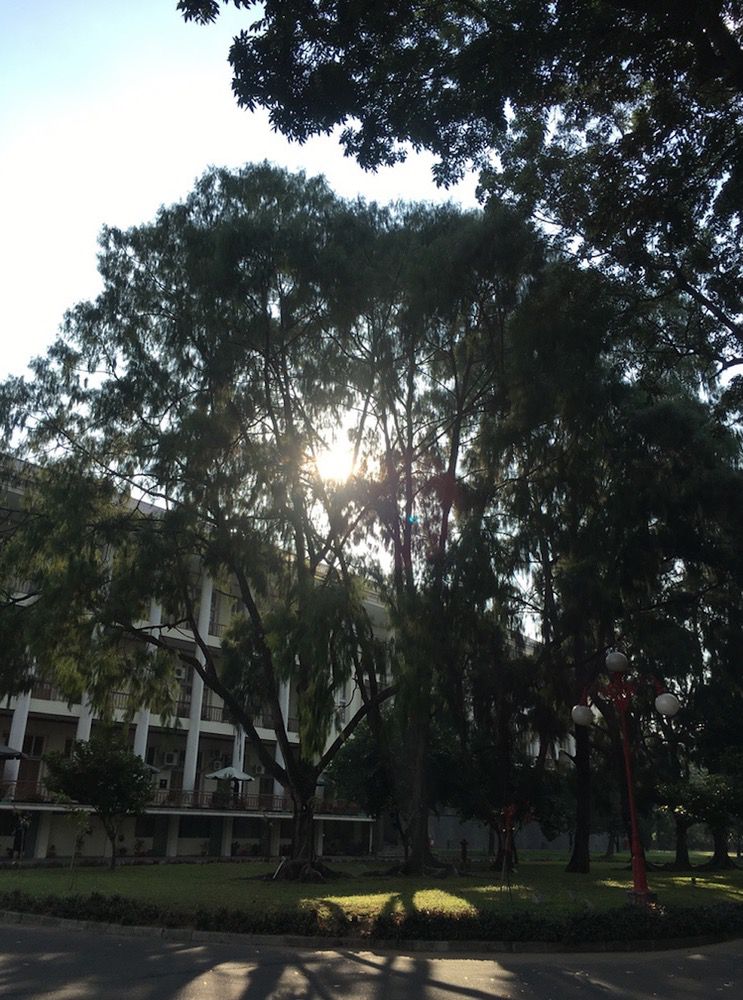
There’s a stretch of road, maybe two hundred meters, where the trees overhead are thick enough to block the early light. For those few seconds it is dark, and the air is cold enough that you feel it on your forearms. Then the road opens up again and there she is.
When I was middle schooler in Papua, I saw a lot kind of her. Everytime we can came home early from school, me and my classmates would cross 2 mountains with a ridiculous name, Gunung Empat Ratus and Gunung Aduh Mama, then find our sanctuary in the middle of her. We called it “Batu Tengah”, a majestic crystal clear river that runs in the heart of our little town. In the middle of this river you can see a huge rock that strangely popped up (hence the name is Batu Tengah) and serves as a resting spot while we were swimming arround.
I think about Batu Tengah more than I should. The water was so clear you could count the stones at the bottom. Grey, brown, some flecked with what we were convinced was gold but was probably just mica. We’d jump from the rock and the cold would grab your chest for one second before your body remembered how to breathe. The current carried our shouting downstream, toward the older kids who fished with lines made from sewing thread and bent safety pins.
The jungle around the river was thick in a way no city park is. Rain would reach you thirty seconds after it started. First you heard it on the leaves above, then the drops came through, warm by the time they landed. The air smelled like wet bark and something faintly sweet, maybe rotting fruit, maybe flowers. You couldn’t always tell.
We didn’t know the names of most trees. We didn’t need to. They were just there, like the sky. The old men in the village could name them, of course. They could tell you which bark cured headaches, which leaves you could wrap fish in for cooking, which roots would make you violently sick. None of it was in books. They knew it because they used it every day.
That knowledge is disappearing now. Nobody decided to get rid of it. People just stopped paying attention, and one thing got replaced by another thing that seemed more useful at the time.
The numbers are staggering. Indonesia has lost over 26 million hectares of forest since 1990, an area larger than the United Kingdom. Between 2001 and 2020, the rate of primary forest loss in Sumatra and Kalimantan averaged roughly 500,000 hectares per year. Papua, which held the country’s last great expanse of intact forest, began losing ground rapidly after 2011, just around the time I was writing these words for the first time.
The causes are well documented. Palm oil plantations. Pulp and paper concessions. Mining. Transmigration programs that moved families from Java to the outer islands and gave them forest to clear. Each cause has its own literature, its own advocates, its own counter-arguments. I’ve read enough of them to know the particular fatigue of understanding a problem and being unable to do anything about it.
But 26 million hectares is too large a number to feel. What I can feel is this. The forest behind my school in Papua, the one we walked through to reach Batu Tengah, is smaller now. Not gone, but smaller. The edges have been trimmed back like a hedge, except this hedge took thousands of years to grow and will take thousands more to grow back, if anyone bothers.
The river is still there, I’m told. The rock is still there. But the banks are muddier now, and after heavy rain the water runs brown instead of clear, from the clearing upstream. The old men who knew which bark cured headaches are mostly dead, and their grandchildren work in Jayapura or Jakarta, sending money home to families who now buy paracetamol from the pharmacy in town.
She is similar to what I see back then in Papua. Only much uglier. But, and here’s lies the problem, there’s not much her left for an easy access. People kept chopping her into pieces and replace it with a new shinny thing. Something that I’m sure happen in every single modern city in Indonesia. Not there’s something wrong with being modern though, because it’s the thing that link me to the wider world. But I just hope that more city can find a way to keep at least a small remnant of her arround. Not in the outer circle of city, not in the mountain far away, but in the heart of place where you can passed it by on your daily life.
That’s what I care about with green space in a city. It isn’t the looks, and it isn’t property values, though realtors will tell you it helps. It’s walking past something every day that doesn’t need you. It was here before you arrived and will be here after you leave, if you let it. It grows over a hundred years, and standing next to it makes your own deadlines look small.
Every city in Indonesia is having the same argument right now, whether they know it or not. Build, or keep the trees. The development report counts the new road. Nobody counts the hundred-year-old tree in the cost-benefit analysis, because it doesn’t generate revenue.
Jakarta solved this argument by paving over nearly everything and then wondering why the floods get worse each year. Surabaya built malls where there used to be parks and then spent millions on flood mitigation infrastructure. Yogyakarta, my Yogyakarta, still has pockets. Small ones. Getting smaller.
I ride past them every morning and try to notice. That’s the least I can do.
There is a writer, I think it was Robert Macfarlane, though it might have been someone quoting him, who said that the loss of nature is also a loss of language. When the trees go, the words for trees go with them. When the rivers change, the stories about the rivers become fiction. A people loses the forest, then loses the words for what was lost.
In Papua, the Dani people had dozens of words for different types of sweet potato. The Asmat had specific terms for the sounds a forest makes at different times of day. Those languages held ecological knowledge as precisely as any scientific taxonomy. UNESCO now classifies them as “endangered”, which is a polite way of saying almost gone.
I am not Dani or Asmat. My connection to Papua is biographical, not ancestral. But I stood in those forests as a child, and even the thinning of them registers somewhere in my body. It feels like a phantom limb. I reach for something that used to be there.
As I’m busy with my mind, I realized that I were already in my place. I stopped and look up. There she is: the small forest. She must be a hundred years old, standing there all alone and look content while the morning ray lit up her face. I wave hello, and she grins back.
She doesn’t need my greeting. She doesn’t need my morning visits, or my guilt about what’s happening to her relatives across the archipelago. She just stands there, doing what she has always done. She turns sunlight into sugar, pulls water from the earth, and drops leaves that become soil that feeds her roots.
I stand with my bicycle and watch the light move through her leaves. Behind me, the city is waking up. Engines starting. Metal gates rolling open. The smell of frying oil from the first warung of the day.
She doesn’t notice. She grins.
I tell myself I’ll come back tomorrow. I always do. One day, I know, I’ll come back and find her gone, replaced by a parking lot or a mini-mart or a cell tower. And I’ll stand there on the pavement where she used to be, and I’ll feel the phantom limb again, and I’ll mourn.
But not today. Today she’s still here, and so am I. The morning light is shining through every leaf, the air smells like wet earth, and for a few minutes the city is quiet enough that you can hear her breathe.
For now, that’s enough.