No. 17 After David Carson, 1994
The 180 hours tether that binds everything so you can ignore that relentless button nudges
Button vs anchor battle. On how to stay center while moving sideways.
You are will and substance.
Not a puppet string or pawn to be nudged around by every Tom, Dick, or Harry. Nudge. Nudge. Nudge.
The added wealth, the new doors, the expanding network. Everything that you think would make you the king of the hill, well, sometimes they just god darn quicksand. You might mistake that pull for lifeline rope. They fling open doors to new junctions, possibilities, and, urgh, expectations. Suddenly, everything seems important, seems worth doing. If the world is doing it, why won’t you?
Breathe in. Breathe out.
You need that pause. Don’t yield. Stand firm. Not preaching Zen philosophy, but hey, Zen, if you’re reading this, now you know why you got your name.
At your core is the root. The anchor. It’s what stops you from becoming just another object, dancing to eternal nudge of the button.
That inner compass, the “me-ness”, which when checked, has you nodding, “Ah, that’s unmistakably me.” Hope you can get it. Everything else, the graying hair, the extra pounds, the trending clothes, is merely the wrapping, not the gift. It may evolve in expression or you have different words for it, but you? You’re always you.
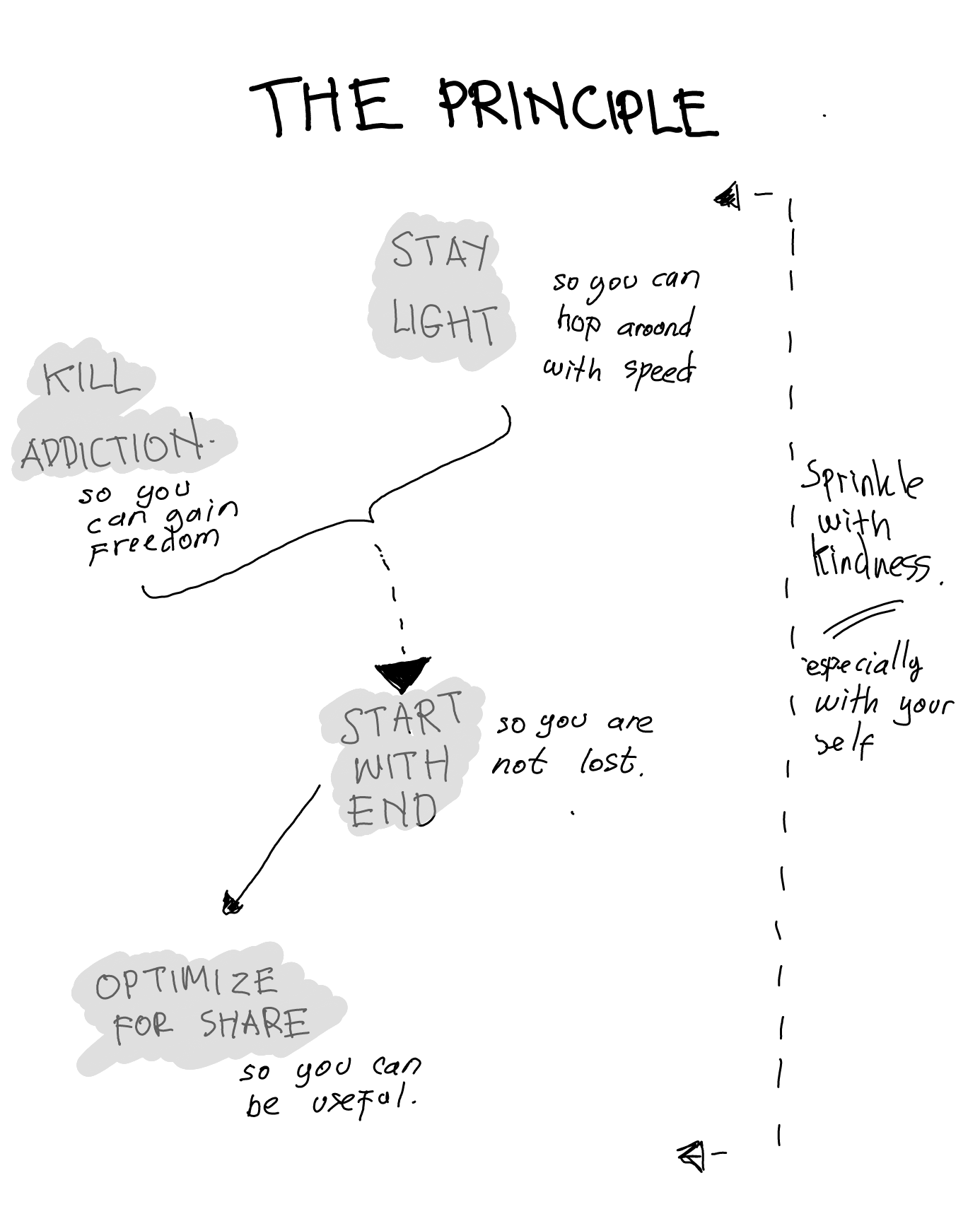
Sure, there will be moments you’ll feel like you’ve lost the plot. But in those moments, look for totem that would help you to stay root. For me, the totem looks like above. But your touchstone it would different. Of course it would different. It might be words, it might be drawing, it might be things. But this totem, you need to see it everyday. Like the thing in that Inception, but of course without the suicidal part.
Let me talk about the totem for a moment. Most people hear the word and imagine something mystical. A crystal, a mantra, a vision board with magazine cutouts and glitter glue. No. A totem, the way I mean it, is much more boring than that. That’s why it works.
Mine is a drawing. You can see it at the top of this page. It’s not beautiful. I’m not an artist. It looks like something a reasonably talented twelve-year-old might produce on a slow afternoon. But those lines, shapes and a few scrawled words hold everything I believe about who I am and what I’m doing here.
I redraw it every year. The core hasn’t changed in a decade, but the emphasis moves. Some years the drawing is heavy on work. Some years it’s heavy on family. Some years there’s a lot of empty space, which tells me something too.
Drawing it is the point. You sit with a blank page and force yourself to answer what actually matters right now. The drawing you end up with matters less than the hour you spent making it. Like tuning a guitar. The guitar doesn’t change. The strings just need tightening.
Christopher Nolan understood this when he wrote Inception. Cobb’s totem, the spinning top, wasn’t magic. It was a way to test reality against expectation. Is this real? Am I where I think I am? Am I who I think I am? The totem doesn’t answer these questions. It makes you ask them.
Now, the 180 hours. It sounds like a lot, and it isn’t.
10 minutes daily. Every morning, before the inbox, before Slack starts pinging, before the first meeting, I spend ten minutes with the totem. Sometimes I write a few words. Sometimes I just stare at it and drink coffee. The point is to check my direction, not to get anything done.
Sailors don’t stare at the compass all day. They glance at it, confirm direction, adjust if needed, and move on. Ten minutes is a glance. But over a year, that’s 60 hours of quietly asking: am I still heading where I want to go?
2 hours weekly. This is the review. Sunday morning, usually, when the house is quiet and the city hasn’t fully woken up. I look at the week behind me and ask three questions:
What did I do that felt like me? What did I do that felt like someone else’s agenda? What do I want next week to feel like?
The last question asks how I want the week to feel, not what I want to accomplish. I’ve had weeks where I checked every box and felt hollow. I’ve had weeks where I did almost nothing measurable and felt completely like myself. The feeling tells me which week was the right one.
Two hours a week is 104 hours a year. With the daily ten minutes, we’re at 164 hours. Almost there.
8 hours semi-annually. Twice a year, I leave. Not a vacation. One day, alone, in a different city. I’ve done it in Semarang. I’ve done it in Solo. Once I did it in a hotel room in Jakarta, which I don’t recommend. Too much noise, and too many temptations to “just pop out for lunch.”
The rules are simple: no work, no email, no social media. Just me, the totem, a notebook, and whatever clarity or confusion I brought with me.
The big decisions happen in these eight-hour sessions. The daily check keeps me on course and the weekly review corrects it. The retreat is where I’ve decided to change careers, end partnerships, start a family, and let go of ambitions that no longer fit.
You can’t make those decisions in a ten-minute morning session. They need space, and the kind of boredom that only comes from sitting with yourself long enough that the shallow thoughts run out and the deeper ones show up.
8 plus 104 plus 60 equals 172. Close enough to 180, give or take the overflow minutes when ten becomes fifteen because you’re onto something.
I should explain what the button is, because I’ve been using it as shorthand. It’s a metaphor, but not entirely.
The button is anything that nudges you toward someone else’s definition of success. The LinkedIn post about the founder who raised $50 million and wants you to know that his morning routine starts at 4 AM. The colleague who just got promoted, and now you’re wondering if you should have played the game differently. The conference speaker who makes you feel like your work is small.
Nudge. Nudge. Nudge.
Each nudge is tiny and harmless on its own. But they add up. Over months and years, they shift your direction by degrees so small you don’t notice, until you look up and realize you’re heading somewhere you never chose.
James Clear writes in Atomic Habits about how tiny changes compound. He’s right, and it works in both directions. Tiny good habits compound into remarkable results. Tiny outside nudges compound into a life that looks impressive on paper and feels like wearing someone else’s clothes.
The totem pushes back against the nudges, and the 180 hours keep it pushing. Nothing dramatic. Just steady enough to keep you pointed where you chose to go.
This would help you to find your color, and express it, amidst the expectations. Its the true confidence. Find it and you will radiate your unique shade, even if circumstance try to paint you differently.
Advice about “finding your color” is worthless without an example, so here is one.
Last year, during a semi-annual retreat in Solo, I realized I’d been taking on client work that paid well but bored me. Not bad work. Not unethical work. Just work that used 30% of my brain and left the rest idle. I was doing it because the revenue looked good and turning down paying clients felt irresponsible.
When I looked hard at my drawing, the section about meaningful work was practically screaming. The section about financial security was fine. More than fine. Once I sat with it long enough, the imbalance was obvious.
I came back from Solo and turned down two contracts. It felt reckless. Six months later, the space I’d made filled with work that used all of my brain. That work, coincidentally, paid better too, because I do better work when I’m interested, and better work gets better rates.
The totem didn’t tell me to do this. It reminded me of what I already knew but had been too busy, too nudged, to act on.
The price for me to create this totem every year is 10 minutes daily, 2 hours weekly and 8 hours semi annually, in other city, undisturbed, unmoved. I’m grateful I have one, and I wish you have yours.
That’s 180 hours to stay yourself. In a year of 8,760 hours, that’s roughly 2% of your time, spent on staying who you are while everything around you tries to make you someone else.
It’s the best investment I’ve ever made. Not the most profitable. Not the most impressive. The best. Every other investment, in skills, relationships, career, health, depends on knowing who you’re investing for. Without that, you’re just piling things up.
Build your totem. Guard your 180 hours. Let the buttons nudge.
You are will and substance. Act like it.